
My Dog Suddenly Won’t Put Weight on a Leg — Is This an Emergency?

One minute your dog is running across the yard, the next they’re holding a leg up and won’t touch it to the ground. Sudden lameness is one of the more common reasons pets come through our doors, and while it isn’t always a broken bone, the only way to know for certain — and to know how urgently you need to act — is to have it evaluated.
Reading the Severity of a Limp
Not every limp is an emergency, but certain patterns tell us a lot before we even touch the leg. A dog who can still bear some weight, even if favoring the leg, is often dealing with a soft tissue injury like a sprain or strain — uncomfortable, but usually not urgent. A dog who holds the leg completely off the ground and refuses to put any weight on it at all is a different story, and is far more consistent with a fracture, dislocation, or significant ligament tear.
Signs That Mean Come In Now
Complete non-weight-bearing lameness, visible swelling that develops rapidly, an obviously deformed or misaligned limb, bone visible through broken skin, or a limp following a car accident, fall, or fight all warrant an immediate emergency visit rather than a wait-and-see approach. Pain that causes your dog to cry out, snap, or become unusually withdrawn is also a signal not to delay.
What Happens During Your Visit
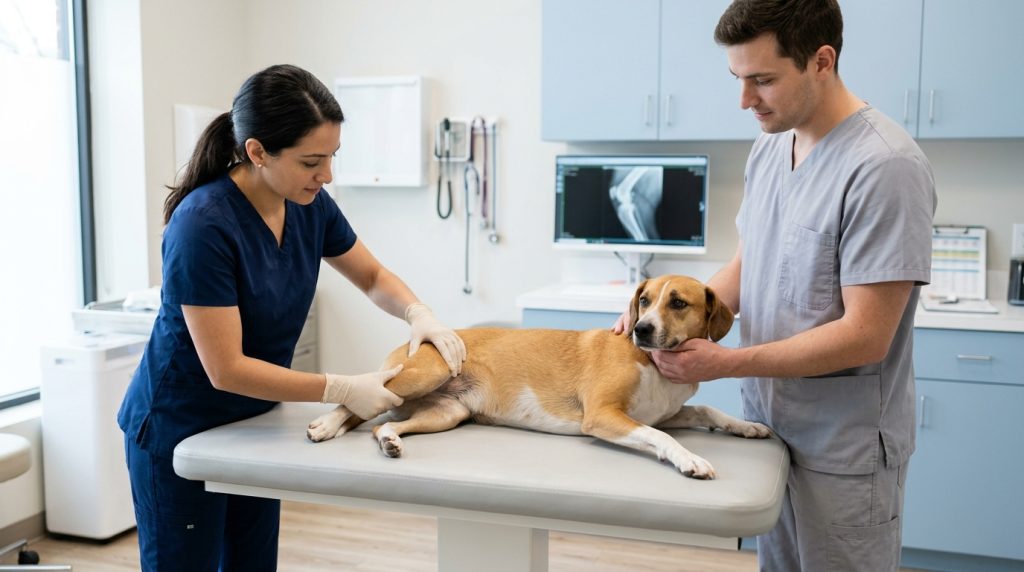
We start with a hands-on orthopedic exam, gently assessing range of motion, swelling, and pain response along the limb. If we suspect a fracture, dislocation, or significant joint injury, we’ll recommend X-rays — often under light sedation, since a painful leg makes it hard for a dog to hold still for a clear image. Our in-house digital radiography gives us answers the same visit, which matters when the next steps depend on knowing exactly what we’re dealing with.
The Range of What Causes Sudden Lameness
Sudden lameness can come from something as minor as a torn toenail or a foxtail lodged between the toes, or as significant as a fractured bone, a torn cranial cruciate ligament, or a luxating patella. In young, large-breed dogs, growing pains (panosteitis) can also cause shifting lameness. Less commonly, gradual or recurring lameness can point toward something like bone cancer, which is why persistent or unexplained limping — even without a dramatic injury — is worth a veterinary evaluation rather than being written off.
Getting to an Accurate Diagnosis
Distinguishing a sprain from a fracture by eye alone is genuinely difficult, even for experienced owners, because both can cause similar pain responses. That’s exactly why imaging matters: it tells us whether we’re managing a soft tissue injury with rest and pain control, or whether your dog needs splinting, casting, or surgical repair. When a case involves a complex fracture or a cruciate ligament tear, our surgery team — led by Dr. Rainier Ko, one of a small number of veterinarians in the country double board-certified in both surgery and neurology — is available for same-day consultation.
What to Do Before You Get Here
Keep your dog as calm and still as possible, and avoid letting them walk on the injured leg any more than necessary. Don’t attempt to splint the leg yourself or give any human pain medications — many are toxic to dogs even at doses that seem small. If a fracture is open or bleeding, a clean cloth applied with gentle pressure while you transport your dog can help until we can take over.
When Every Minute Counts
North Springs Veterinary Emergency & Specialty Center is open 24 hours a day, 7 days a week, 365 days a year. No appointment is ever needed for an emergency — walk in any time, day or night. Our team works alongside in-house specialists in surgery, internal medicine, cardiology, and radiology, so your pet can move seamlessly from emergency stabilization to specialty care under one roof.
North Springs Veterinary Emergency & Specialty Center
10520 White Diamond Pt, Colorado Springs, CO 80908
Phone: (719) 920-4430
northspringsvrc.com
Sources
- Fractured Limbs — American College of Veterinary Surgeons. https://www.acvs.org/small-animal/fractured-limbs/
- Bone Fractures in Dogs and Cats — Merck Veterinary Manual. https://www.merckvetmanual.com/musculoskeletal-system/osteopathies-in-small-animals/bone-fractures-in-dogs-and-cats
- Limping Pets: When a Visit to the Emergency Vet is Necessary — Fountain Valley Emergency Pet Hospital. https://fvpetemergency.com/limping-pets-when-a-visit-to-the-emergency-vet-is-necessary/
- How to Identify Dog Leg Sprain vs Fracture Before Visiting the Vet — North MS Pet Emergency. https://nmspetemergency.com/how-to-identify-dog-leg-sprain-vs-fracture-before-visiting-the-vet/
- Signs of a Broken Leg in Your Dog — Pinnacle Veterinary Specialists. https://pinnacle.vet/blog/broken-leg-in-dogs/