
My Cat Is Straining to Urinate — Could It Be a Blockage?
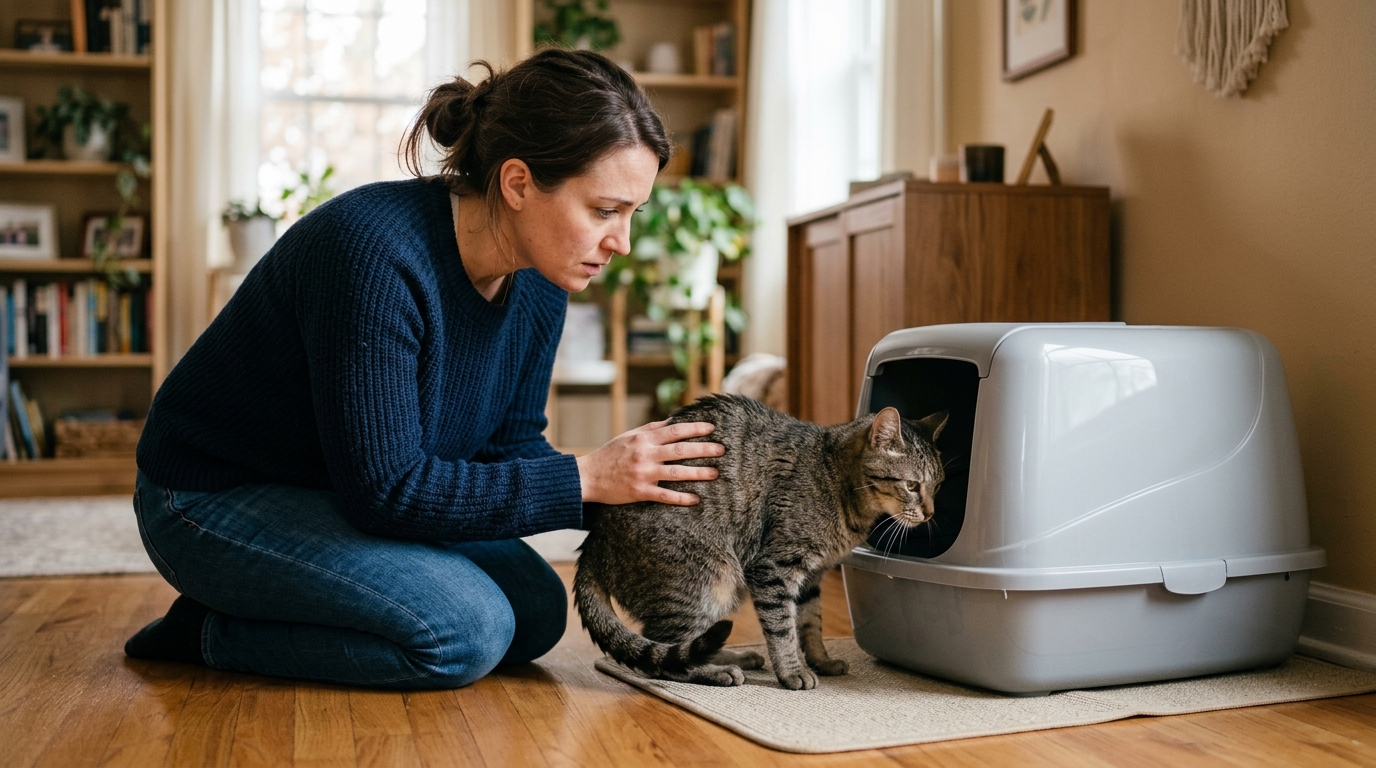
In my years of emergency veterinary practice, few calls are more urgent than an owner reporting that their cat has been in and out of the litter box all night without producing urine. A urinary obstruction — commonly called a “blocked cat” — is a life-threatening emergency that can turn fatal within 24 to 48 hours if left untreated. Unfortunately, it is also one of the most commonly missed emergencies at home, because the straining looks so similar to constipation.
What Is a Urinary Blockage in Cats?
A urinary obstruction occurs when something — a mucus plug, urinary crystals, a small stone, or scar tissue — lodges in the urethra and prevents urine from exiting the bladder. As the bladder fills and cannot empty, pressure builds. The kidneys, which rely on the ability to push urine out, begin to back up. Toxins that are normally cleared in urine accumulate in the bloodstream, leading to a cascade of metabolic disturbances including life-threatening elevations in potassium that can cause cardiac arrest.
Male cats are overwhelmingly more affected than females, simply because the male urethra is long and narrow — particularly at the penile urethra — making it far easier for a plug or crystal to become lodged. Females can develop obstructions, but it is far less common.
Which Cats Are Most at Risk?
While any male cat can develop a urinary obstruction, certain factors increase the risk significantly:
- Neutered male cats (the urethra narrows further after neutering)
- Cats fed exclusively dry food diets, which produce more concentrated urine
- Overweight or sedentary cats
- Cats with a history of urinary crystals or feline idiopathic cystitis (FIC)
- Cats under significant stress — a frequently overlooked trigger
- Persian and Himalayan breeds, which have a higher rate of crystal formation
Cats that have had one obstruction are at significant risk of recurrence. Roughly 30–40% of cats will block again within the first year without preventive management.
What Are the Signs of a Blocked Cat?
The classic presentation is a cat that is:
- Making frequent trips to the litter box
- Squatting and straining with little or no urine produced
- Vocalizing — crying, howling, or growling — in or around the litter box
- Licking excessively at the genital area
- Appearing restless, uncomfortable, or hunched
As the obstruction progresses and toxins build up, you may see:
- Vomiting
- Loss of appetite
- Lethargy or collapse
- Open-mouth breathing
- Hiding
One of the most important distinctions to make: a straining cat is not necessarily constipated. Many owners assume their cat is constipated when they see repeated squatting. If there is any doubt, a physical examination by a veterinarian is the only way to tell the difference. Do not wait and see.
How Is a Urinary Obstruction Diagnosed?
Diagnosis begins with a physical examination. A skilled clinician can typically feel a large, firm, painful bladder in the abdomen — a normal bladder is small and difficult to palpate. Blood work is essential to assess kidney values and, critically, potassium levels. Severely elevated potassium causes characteristic changes on an electrocardiogram (EKG) and can result in life-threatening cardiac arrhythmias that must be addressed before or during unblocking.
X-rays or ultrasound may be obtained to look for urinary stones (uroliths) or other structural abnormalities contributing to the obstruction.
How Is a Blocked Cat Treated?
Treatment involves several simultaneous steps:
- Intravenous fluid therapy to rehydrate the cat and begin flushing toxins from the bloodstream
- Stabilization of cardiac arrhythmias if potassium is critically elevated
- Sedation or anesthesia and passage of a urinary catheter to relieve the obstruction
- Flushing of the bladder to remove debris, crystals, and inflammatory material
- An indwelling urinary catheter is typically left in place for 24–72 hours while the urethra recovers
Most cats require a hospital stay of two to four days. After discharge, dietary modification — typically transitioning to a prescription urinary diet and increasing water intake — is a cornerstone of long-term management. Some cats with recurrent obstructions may be candidates for a surgical procedure called a perineal urethrostomy (PU), which permanently widens the urethral opening. North Springs’ surgical team performs perineal urethrostomy and can discuss whether your cat is a candidate.
Can Urinary Blockages Be Prevented?
Complete prevention is not always possible, but the following measures meaningfully reduce recurrence risk:
- Feed a veterinary-prescribed urinary health diet
- Transition to wet/canned food to increase daily water intake
- Provide multiple water sources, including running water fountains
- Maintain a healthy body weight
- Reduce environmental stress — provide adequate litter boxes (one per cat plus one), vertical space, and routine
- Schedule regular veterinary checkups and urinalysis for cats with a history of urinary issues

Prognosis
Cats that receive prompt treatment for a first-time obstruction have an excellent short-term prognosis, with survival rates exceeding 90% at experienced facilities. Cats that arrive with severe metabolic derangements or have been obstructed for more than 48 hours face a more guarded outlook. Early recognition and intervention are the most important factors in a good outcome.
When to Go to the Emergency Vet
If your cat has been in and out of the litter box repeatedly without producing urine — or is producing only drops — this is an emergency. Do not wait until morning. A blocked cat can die within 24–48 hours without treatment.
North Springs Veterinary Emergency & Specialty Center has emergency veterinarians available 24 hours a day, 7 days a week to evaluate and treat urinary obstructions. Our surgical team also performs perineal urethrostomy for cats with recurrent blockages. Come directly to Come to 10520 White Diamond Pt, Colorado Springs, CO or call (719) 920-4430.
Sources and Further Reading
- Gerber B, et al. “Evaluation of clinical signs and causes of lower urinary tract disease in European cats.” Journal of Small Animal Practice. 2005;46(12):571–577.
- Lekcharoensuk C, et al. “Association between patient-related factors and risk of calcium oxalate and magnesium ammonium phosphate urolithiasis in cats.” JAVMA. 2000;217(4):520–525.
- Segev G, et al. “Urethral obstruction in cats: predisposing factors, clinical, clinicopathological characteristics and prognosis.” Journal of Feline Medicine and Surgery. 2011;13(2):101–108.
- Westropp JL, Buffington CA. “Feline idiopathic cystitis: current understanding of pathophysiology and management.” Veterinary Clinics of North America: Small Animal Practice. 2004;34(4):1043–1055.
- International Cat Care. “Feline Lower Urinary Tract Disease (FLUTD).” icatcare.org. https://icatcare.org/advice/feline-lower-urinary-tract-disease-flutd/
This article is written for educational purposes and does not constitute veterinary medical advice. If your pet is experiencing a medical emergency, seek immediate veterinary care.